The Child in the Photograph Became an Artist
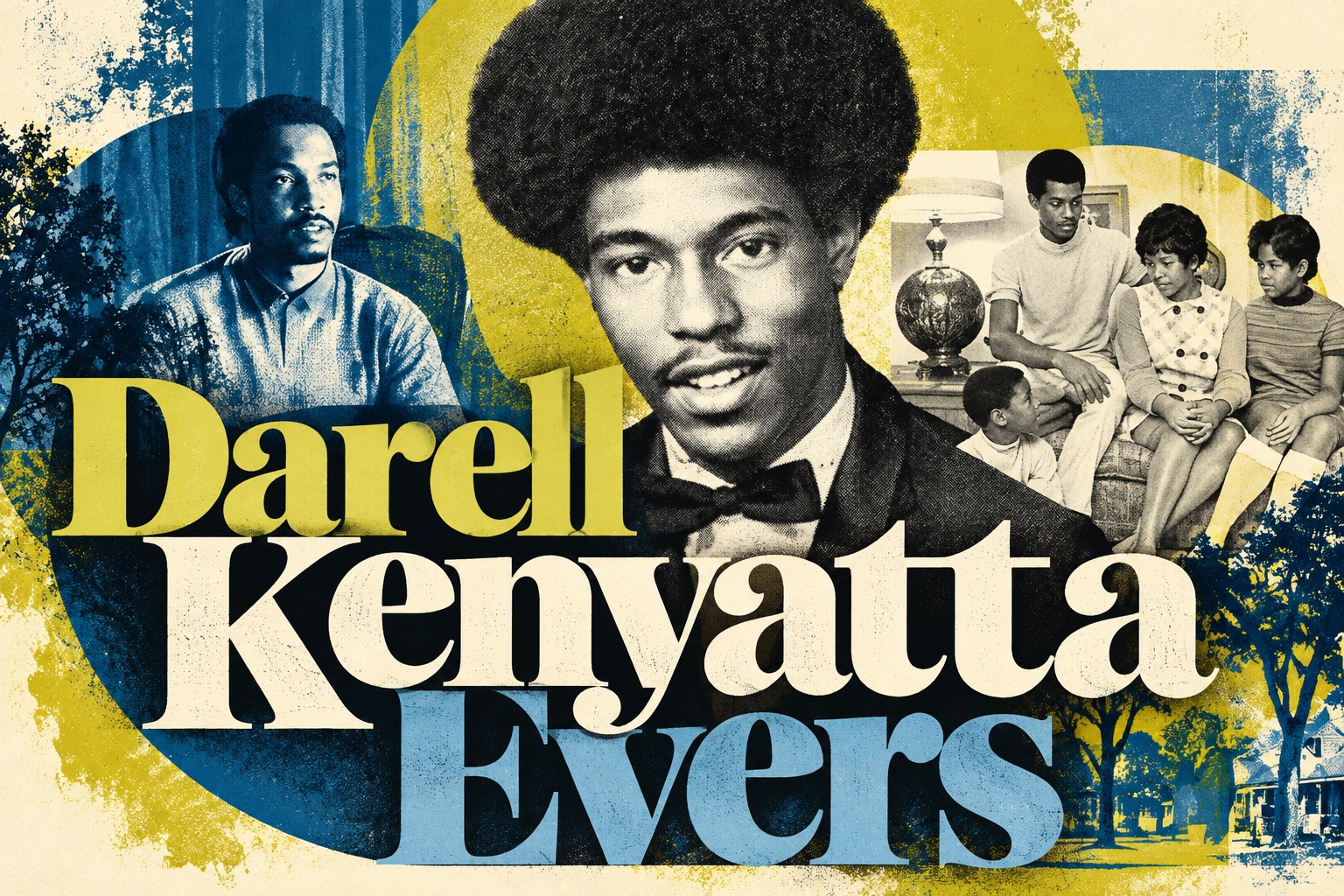
Darrell Kenyatta Evers is often remembered as the grieving son of Medgar Evers. That image belongs to American history, but I find it essential to follow his life beyond childhood. He became a painter, a business founder, a husband, and a father. The tragedy that made his family nationally visible did not contain the whole of the man he became.
Darrell was born on June 30, 1953, in Mound Bayou, Mississippi. He was the eldest of Medgar and Myrlie Evers’s three children. He died on February 18, 2001, at 47, after developing colon cancer. Between those dates, his life moved from the center of the civil rights struggle into artistic and entrepreneurial work in California.
Medgar and Myrlie’s Eldest Child
Medgar Wiley Evers served as the NAACP’s field secretary in Mississippi. His work challenged racial exclusion and placed him and his family under severe threat. On June 12, 1963, he was assassinated outside the family’s home in Jackson.
Darrell was nine, only weeks short of his tenth birthday. The assassination was a national event, but for him it was first the violent loss of his father. Photographs of Myrlie comforting her children at the funeral made the family’s grief visible to people far beyond Mississippi.
I return to the age because it changes the perspective. A nine-year-old did not choose to become a symbol of the cost of racism. Darrell’s later public reflections came from someone who had lived the event as a child before understanding all of its historical dimensions.
Myrlie and the Family After 1963
Myrlie Evers continued raising Darrell, Reena, and James after Medgar’s death. She also sustained a public commitment to civil rights and the pursuit of justice. Her later career included serving as chair of the NAACP’s board, writing, and advocacy.
She later married Walter Williams and became widely known as Myrlie Evers-Williams. Her life included both the preservation of Medgar’s legacy and professional work of her own. I see her role in Darrell’s story as substantial without reducing her to the task of keeping another person’s memory alive.
The family eventually relocated, and Darrell developed his adult life in California. That move changed the setting around him, but the history of Jackson remained part of the family’s shared experience. Geography could open a new chapter without removing the earlier one.
Reena and James
Darrell’s sister, Reena Denise Evers-Everette, became an active steward of the family legacy through the Medgar and Myrlie Evers Institute. Her work has involved public remembrance, education, and the continuing relevance of her parents’ civil rights commitments.
His younger brother, James Van Dyke Evers, also known as Van, became a photographer. The siblings therefore developed different kinds of public work. Reena’s institutional activity, James’s photography, and Darrell’s painting each offered a distinct way of engaging with people and experience.
I find the artistic connection between the brothers especially striking. Painting and photography both make images, but they do so through different relationships with the visible world. Their careers should not be merged into a general description of the Evers children as activists alone. Each had an individual working life.
Painting as an Independent Practice
Darrell studied painting at ArtCenter College of Design in Pasadena and became known as an avant-garde artist. His work addressed subjects including prejudice and the life and death of his father. Those themes linked his art with personal history while giving it a form different from a speech or commemorative statement.
A painting can hold tension without resolving it into a single argument. That is part of what interests me about Darrell’s chosen medium. He could work through color, form, and composition in a space where memory did not need to follow the sequence of a courtroom account.
His paintings entered private collections, and his artistic identity was recognized beyond the fact of his parentage. The available account does not establish a complete catalogue or a list of major national awards. It does establish sustained engagement with painting, which deserves a place at the center of his adult biography.
Lauren and a Business in Emerging Technology
Darrell and his wife, Lauren, co-founded Intellikey Labs during the 1990s. The company worked in DVD quality control and served major film studios. This enterprise placed him within a developing part of the entertainment technology business, far from the usual public image of a civil rights leader’s son.
I find the transition from painting to technical quality control unexpectedly compelling. The two activities require different methods, yet both depend on close attention to what is in front of the eye. That is an editorial parallel, not a claim about why Darrell chose the business.
Lauren was both his spouse and business collaborator. Their son, Keanan, was among the family members who survived him. The company’s success is part of Darrell’s occupational record, but his personal wealth is not publicly established through a reliable financial disclosure.
Speaking About the Past
Darrell participated in interviews about his father’s death and the family’s experience. He also appeared as himself in the 1996 film Ghosts of Mississippi, which concerned the effort to secure a conviction for Medgar’s murder.
That appearance brought the adult Darrell into a dramatization of events that had shaped his childhood. I see it as a particularly unusual crossing of personal life and historical representation: a family member standing within a film built around a case his family had endured for decades.
FAQ
Who were Darrell Kenyatta Evers’s parents?
His parents were civil rights leader Medgar Wiley Evers and activist Myrlie Evers-Williams. He was their eldest child, followed by Reena and James.
What did Darrell do professionally?
He was an avant-garde painter and an entrepreneur. He studied at ArtCenter College of Design and co-founded the DVD quality-control company Intellikey Labs with his wife, Lauren.
How old was he when his father was killed?
Darrell was nine when Medgar Evers was assassinated on June 12, 1963. His tenth birthday would have been on June 30.
When did Darrell die?
He died on February 18, 2001, at age 47, from colon cancer. His surviving family included his wife Lauren, son Keanan, mother Myrlie, and siblings Reena and James.